

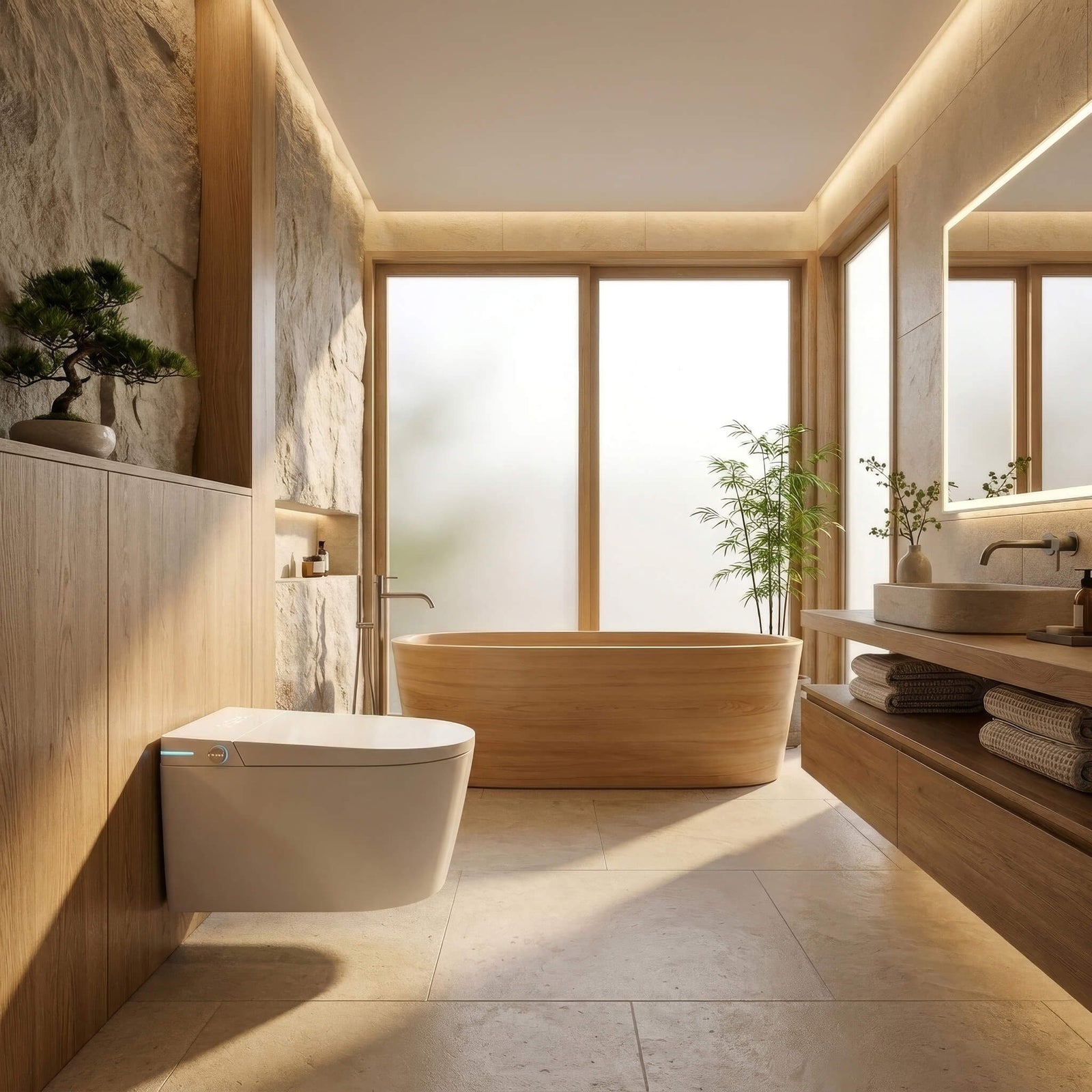
For most of the world, the toilet hasn't changed in a century. In Japan, it changed decades ago — and once you've stepped into a warm seat and a warm-water wash on a cold morning, an ordinary toilet feels like a step backwards. Here's everything worth knowing about Japanese smart toilets: what they are, how they work, what they cost, and whether one belongs in your bathroom.
What is a Japanese smart toilet?
A Japanese smart toilet — also called a smart toilet, bidet toilet or shower toilet — is an all-in-one intelligent toilet that replaces toilet paper with a warm-water wash, and adds a level of comfort and hygiene an ordinary toilet simply can't. At its heart is a retractable nozzle that delivers a temperature- and pressure-adjustable cleanse, a gently heated seat, warm-air drying, and a lid that opens and closes for you. The better models add charcoal deodorisation, a self-cleaning UV-sterilised nozzle, a soft night light, and a wireless remote.
In Japan this isn't a luxury — it's simply the standard, found in the majority of homes. What's new is that the same technology has finally arrived, properly engineered, in British bathrooms.
How does a Japanese toilet actually work?
Everything is sensor-led. As you approach, the lid opens; the seat is already warm. When you're ready, a nozzle extends and delivers a warm-water wash you control by temperature, pressure and position — far more thorough, and gentler, than paper. Warm-air drying follows, so you leave fresh without reaching for a roll. Between uses, the nozzle retracts, self-cleans and sterilises under UV, and many models coat the bowl with a protective foam to reduce splash and odour. It flushes as you leave.
Is it more hygienic than toilet paper?
Yes — water cleans more completely than paper, and because the wash is touch-free and the nozzle self-sterilises, there's less to handle and less to clean. It's also kinder for sensitive skin and a genuine help for anyone with limited mobility. It's why warm-water washing is standard not just in Japanese homes, but in their hospitals and hotels.
What does a Japanese smart toilet cost?
To buy: quality complete units in the UK typically start around £1,195 and rise with features and finish. At Tresani, the range runs from the essential Origin up to signature models with illuminated detailing and user memory — you can compare them all in our buying guide.
To run: less than you'd think — typically £50–£80 a year in electricity for a household of four, and that's often offset by what you save on toilet paper.
Do you need a plumber?
Yes — a qualified plumber and electrician. Each unit needs a water supply, a waste outlet and a nearby fused electrical spur. It's a straightforward job for a professional, and most installs are done in a morning. One UK-specific point: every Tresani has a built-in water tank, so it delivers a full, confident flush even in low-pressure homes.
Are they worth it?
If you've never used one, the honest answer is that the heated seat alone wins most people over in the first week — and the warm-water clean is the thing they then can't live without. It's a small daily ritual that quietly improves, every single day.
How to choose
Start with two questions: which form suits your bathroom — wall-hung (floating, space-saving) or floor-standing (full-size presence) — and how much do you want it to do. Our Find Your Tresani guide walks you through the whole range in two minutes.
Frequently asked questions
Do Japanese toilets need electricity? Yes — they run from a standard fused spur. Tresani models include a backup battery for power cuts.
Can you still use toilet paper? Of course — but most people find they barely need to.
Will it work with UK water pressure? Yes. A built-in water tank guarantees a full flush even in low-pressure homes.
What happens in a power cut? A backup battery gives up to 50 flushes, and power-off flushing means it always works.
Ready to bring the ritual home? Explore the Tresani range →


Share: