

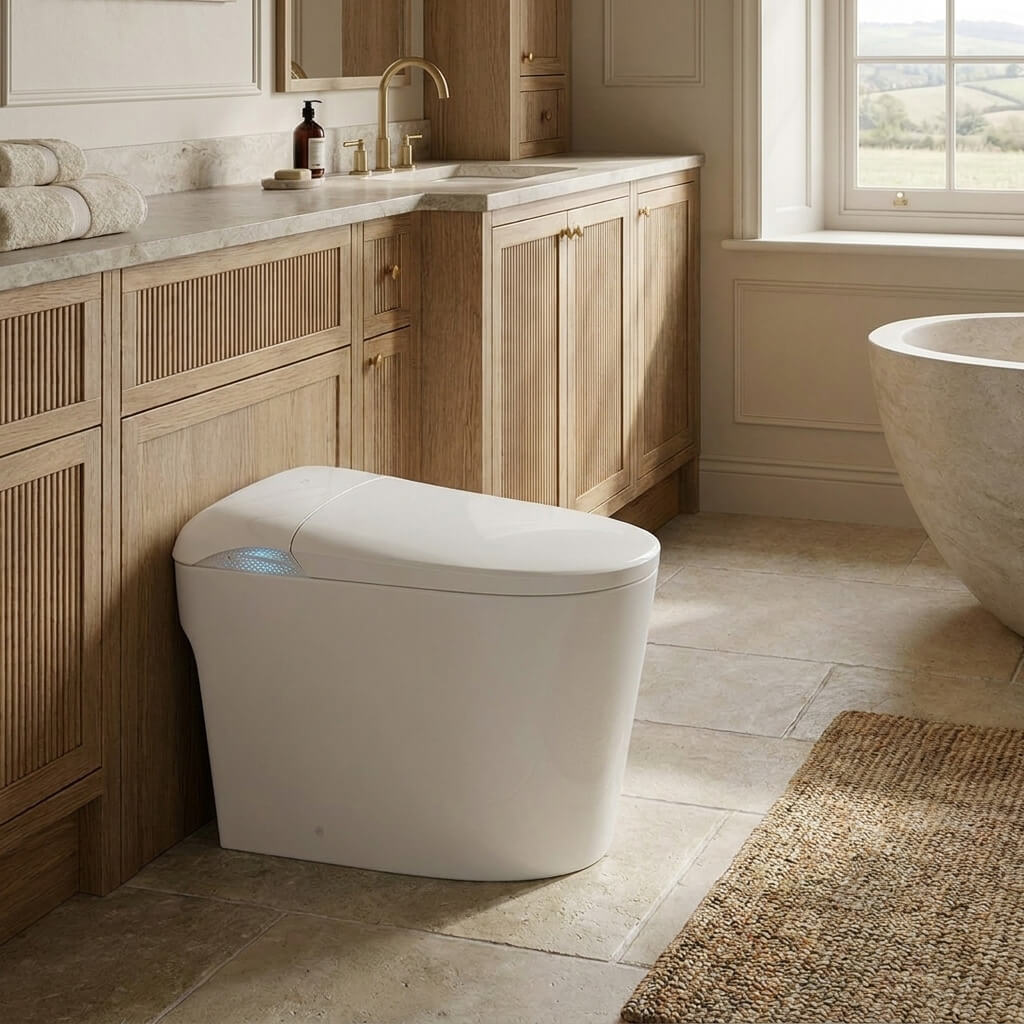
For most people who buy one, yes, an integrated Japanese smart toilet is worth it, because it improves something you use several times a day, every day, for years. That is the honest test. A sofa earns its keep by being sat on; a smart toilet earns its keep the same way. Below is a straight look at what you are paying for, who benefits most, the objections worth taking seriously, and how to decide without the marketing gloss.
What you are really paying for
You are not paying for novelty. You are paying for daily comfort and better hygiene, made automatic. The warm seat, the adjustable warm-water wash, the warm-air dryer and the deodoriser are not gimmicks once they are part of your routine; they are the reason the room feels calmer and cleaner. Washing with water rather than relying on paper is gentler and, over time, means the household buys far less paper. And because the unit is rimless and largely self-cleaning, you spend less of your life scrubbing a bowl. There is a design dimension too: this is a fixture you look at and touch every day, so a considered, quiet object earns its place in a way a disposable one never does. For how the running costs actually stack up, see our breakdown of what a Japanese smart toilet costs.
Who benefits most
Some households feel the difference more sharply than others. Families with young children appreciate the hygiene and the hands-free flush in a shared bathroom. New parents value a warm-water wash during a tender postnatal period. People with reduced mobility or limited grip find the touchless lid, auto-flush and remote genuinely easier to live with, a point we expand on in our article on smart toilets and accessibility. And design-led homeowners, the people who chose the taps and the tiles carefully, tend to be the ones who most resent a cheap toilet undoing the room. If any of those describe you, the value proposition is straightforward.
The objections, answered honestly
The first is cost. A good integrated unit starts from around £1,195, which is more than a basic pan but in line with a quality bathroom fixture you keep for many years. Spread over its life, and with 0% finance available, it reads differently than the sticker alone suggests.
The second is electrics. Yes, these units need a power supply, because heating water on demand and warming a seat takes electricity. In practice that means a fused spur positioned by a qualified electrician, which is routine work; we cover it in do smart toilets need electricity.
The third is reliability. A smart toilet has more in it than a basic one, so it is fair to ask. The answer is to buy a complete, properly engineered unit rather than a cheap bolt-on, and to choose a brand that stands behind it, which is why our cover includes a lifetime ceramic warranty alongside a two-year guarantee on the working parts.
The fourth is the quiet one: do I really need it. No one needs a heated seat. But the same is true of a comfortable bed or a good shower, and few people who have lived with those go back. The honest framing is not need but whether the daily improvement is worth the outlay to you.
The long view
A smart toilet is a long-term fixture, not a gadget you replace in two years. The lifetime ceramic warranty reflects that, and 0% finance means the cost need not arrive all at once. If you want a sense of where we sit against the obvious alternative, our Tresani versus TOTO comparison is a fair place to start.
The best way to decide is to match a model to your bathroom and your priorities. Our buying guide does exactly that, and you can browse the full range to weigh the options.


Share: