

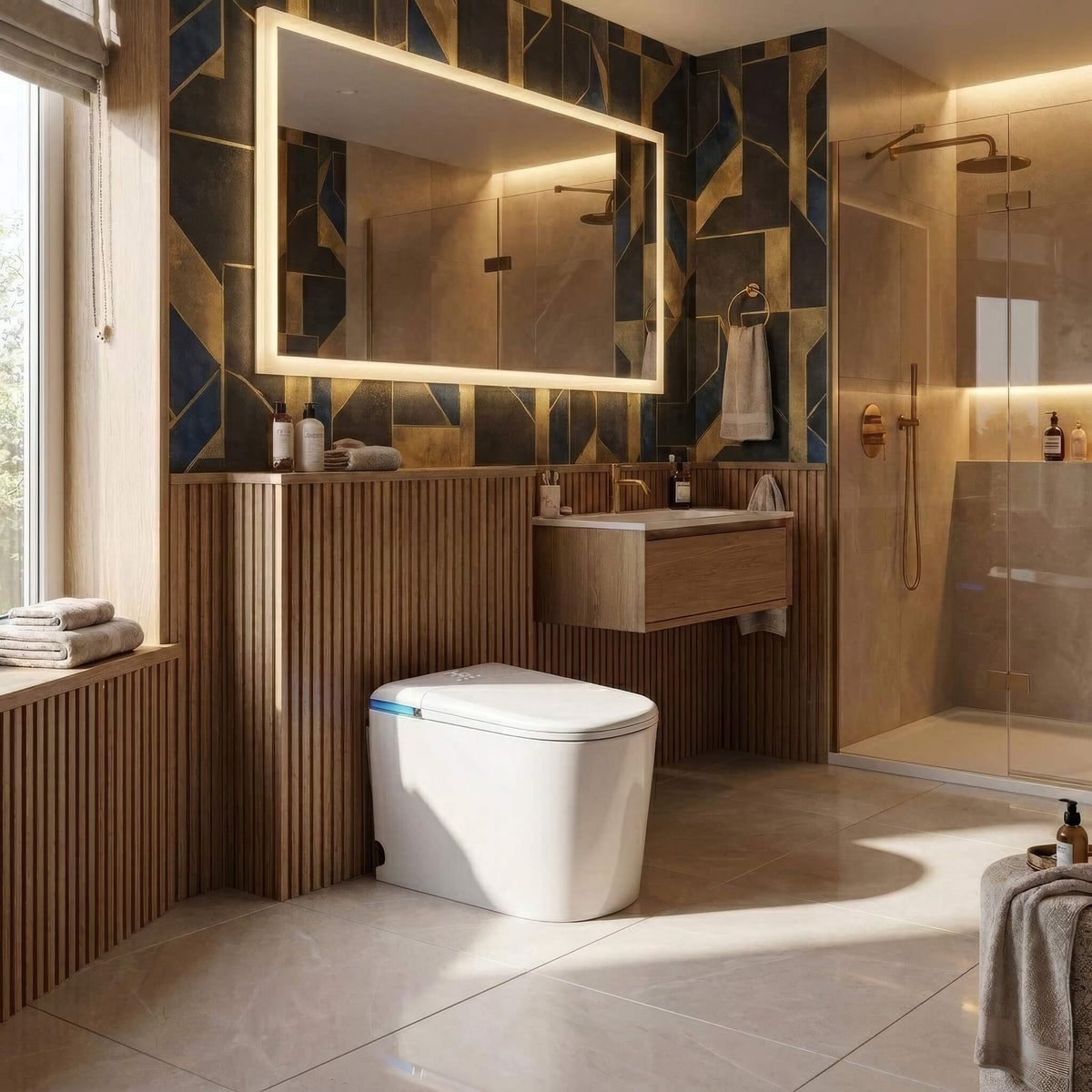
The difference is straightforward: a bidet seat is a separate attachment that bolts onto an existing toilet, while an integrated smart toilet is a single, complete unit designed as one object from the ceramic up. A seat adds washing and drying to a pan you already own. An integrated unit builds those features into the pan itself, with the technology hidden and the proportions resolved. Both can wash and dry; they are not equal in design, performance or longevity.
What a bidet seat is
A bidet seat replaces your ordinary toilet seat with a powered one. It plugs into the mains, taps into your water supply, and gives you a warm-water wash and, on better models, a warm-air dry and a heated seat. It is the quickest way to add washing to a bathroom, and it is usually the cheapest.
The compromises show up in three places. First, the join: there is a visible seam where the seat meets a pan it was never designed for, and a control housing that sits proud at the back. Second, the proportions: bidet seats tend to be bulkier than a standard seat, so the result can look heavier than you expect. Third, the match: your existing pan sets the shape, height and colour, and a bolt-on rarely lines up perfectly with it. Wash and dry functions are often more limited too, since everything has to fit inside the seat.
What an integrated smart toilet is
An integrated smart toilet is designed as a whole. The bowl, the wash, the dryer, the seat and the controls are part of one considered object, so there is no seam and nothing bolted on. The bowl is typically rimless, which is cleaner and easier to maintain, and the technology lives out of sight. Because nothing has to be retrofitted, the feature set is usually fuller: adjustable warm-water washing, a warm-air dryer, a deodoriser, a heated seat, a soft night light, and on premium models an auto-open and soft-close lid with touchless flush.
The real difference is coherence. An integrated unit reads as a single piece of design rather than a good idea attached to an old fitting. For a bathroom you care about, that matters.
When a bidet seat makes sense
We will be honest about this. A bidet seat is the right answer in some situations. If you rent and cannot replace the toilet, a seat lets you take washing with you when you move. If your budget is tight, a seat is a real step up for far less money. And if you simply want to try heated, warm-water washing before committing to a full unit, a seat is a sensible way in. There is no shame in starting there.
What a seat will not give you is the rimless bowl, the hidden technology, the resolved proportions or the longevity of a unit built as one. It is an upgrade to a toilet, not a new one.
Why Tresani makes complete units
Tresani builds integrated smart toilets, not bolt-on seats. The reasoning is design-led: we would rather make one object that is right than improve one that is already there. Every model has a rimless wash bowl, the technology concealed, and the features built in rather than added. The result is meant to be lived with for years, with a lifetime ceramic warranty behind it.
It is a Japanese-inspired idea: the everyday made calm and considered, rather than patched. If you are weighing a seat against a full unit, it helps to understand how the technology actually works and whether an integrated unit is worth it for you. When you are ready, browse the range or use our buying guide to narrow it down.


Share: